
T. Vasselon, U. Ahmad, C. Geffroy, L. Mazzella, M. Aluffi, S. Ouacel, J. Shaju, et al.
arXiv:2609.28224
Efficient on-chip sources and detectors of picosecond electrical pulses that keep working at cryogenic temperatures.
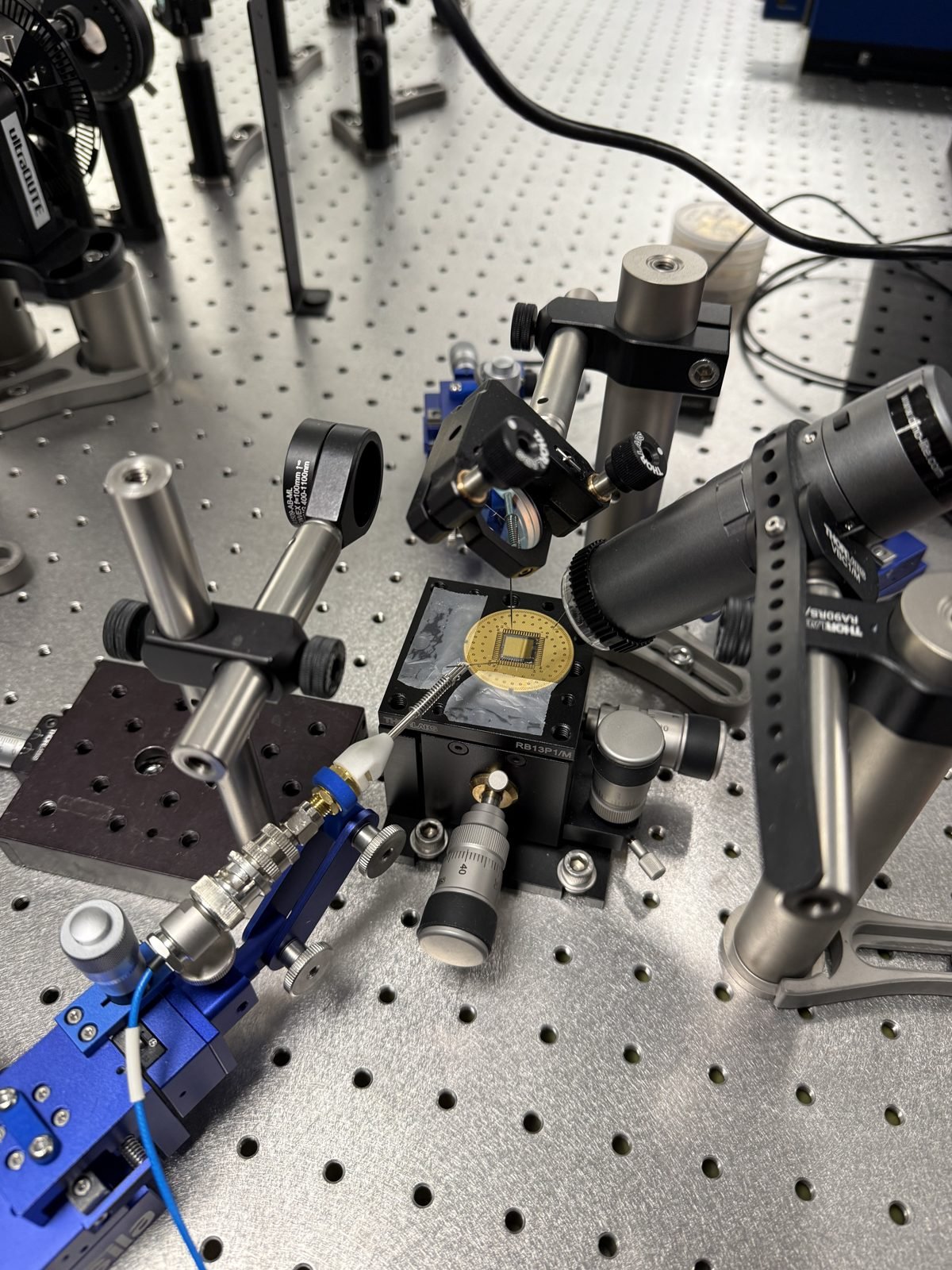
The shortest electrical pulses are made using opto-electronic methods. A femtosecond laser pulse lands on a photoconductive switch, a small gap in a transmission line made on a semiconductor with a very short carrier lifetime, and for a few picoseconds the gap conducts. The result is an electrical pulse with frequency content extending into the terahertz range.
Making this work next to a quantum device brings constraints. The laser power must be low, because every milliwatt heats the sample, so the switch has to be efficient. It must also operate at cryogenic temperatures and be compatible with the fabrication of the quantum circuit beside it.
We are developing three-dimensional photonic-plasmonic photoconductive switches that absorb the laser light far more efficiently than a planar switch. We characterise sources and detectors for low-temperature operation and study alternative materials, including germanium, as cost-effective and CMOS-compatible semiconductors for THz electronics.
The same integrated THz circuits are a measurement tool. An electrical THz pulse sent through a material or a nanostructure reveals its high-frequency transport properties, which makes on-chip THz optoelectronics useful for material and electronic transport characterisation.
Nanoelectronics at THz frequencies · Quantum technologies at THz frequencies · Flying electron qubits and electron interferometry · Nanofabrication of quantum devices
Interested in working on this? See our open positions.