
T. Vasselon, U. Ahmad, C. Geffroy, L. Mazzella, M. Aluffi, S. Ouacel, J. Shaju, et al.
arXiv:2609.28224
Driving and reading out nanoscale electronic devices with picosecond pulses, a thousand times faster than conventional gigahertz electronics.
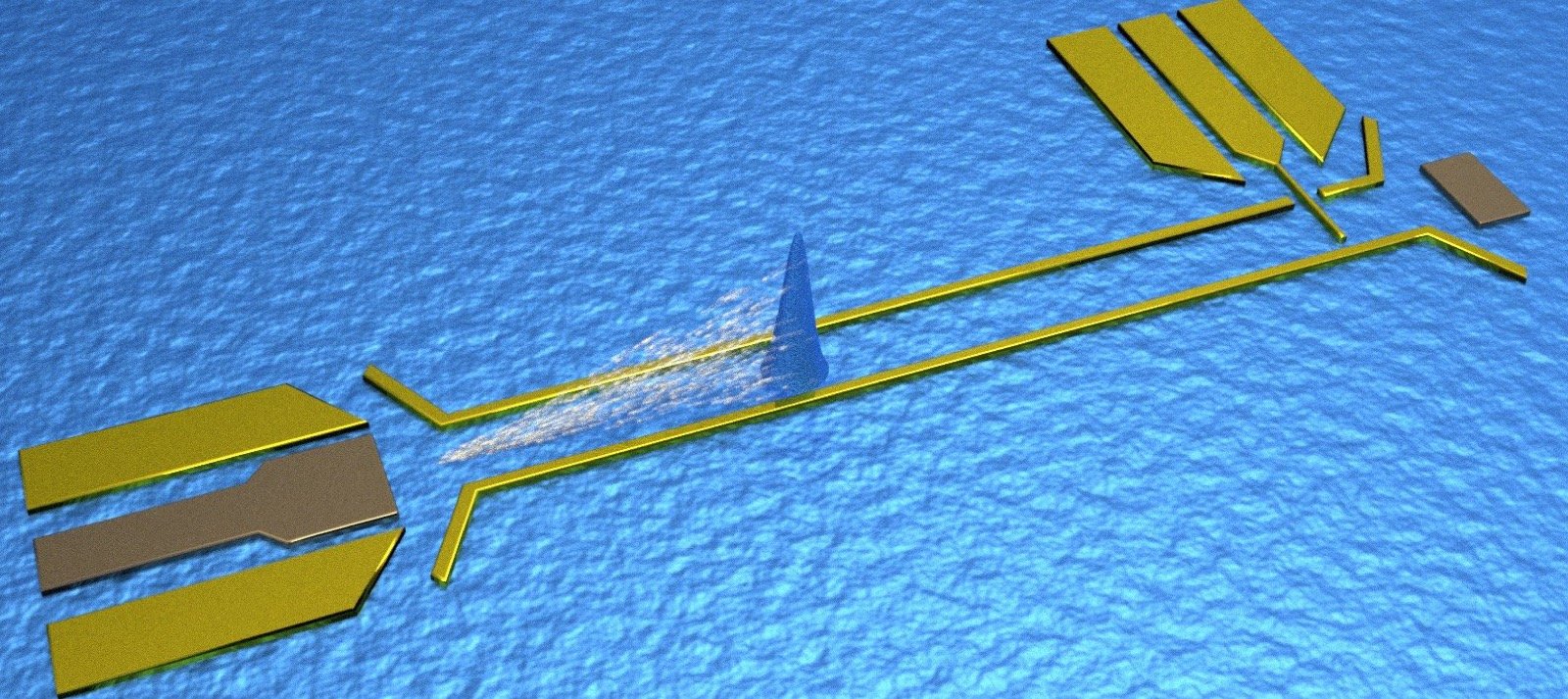
Conventional nanoelectronics is driven at gigahertz frequencies, where a signal takes nanoseconds to change. At terahertz (THz) frequencies the same change takes picoseconds. That timescale is short enough to act on an electron while it is still crossing a device a few micrometres long, and it opens a regime where the electronics is as fast as the physics it is trying to control.
The difficulty is that standard microwave sources, cables and amplifiers stop working well before 1 THz, and almost none of them operate inside a cryostat. Our group develops the missing pieces: on-chip sources of picosecond pulses, waveguides that carry them to a nanoscale device without distortion, and ways of detecting the result with picosecond time resolution.
We integrate THz optoelectronics and coplanar waveguides on the same chip as a quantum nanoelectronic device, fabricated on AlGaAs/GaAs heterostructures. A femtosecond laser triggers a photoconductive switch, which launches a voltage pulse along the waveguide and into the device. A second, delayed laser pulse samples the signal that comes out. This approach is essentially one of the fastest methods for capturing an image at scales approaching as fast as one trillionth of a second.
With this approach we have injected electron wavepackets as short as 4 ps into a quasi-one-dimensional electron waveguide and controlled how fast they propagate. We also study how these wavepackets, which travel as collective plasmon excitations, spread among the conduction channels of a device and how that spreading can be switched off.
Most of our devices use the two-dimensional electron gas in GaAs heterostructures, where electrons travel for many micrometres without scattering. We are extending the same techniques to 2D materials, whose electronic properties suit ultrafast operation, and to germanium as a low-cost, CMOS-compatible semiconductor for THz electronics.
Quantum technologies at THz frequencies · Flying electron qubits and electron interferometry · Cryogenic THz optoelectronics · Nanofabrication of quantum devices
Interested in working on this? See our open positions.